

Traditional search engines focus on listing links, leaving users to find answers themselves. AI-powered search engines are changing this model by delivering direct, contextual answers using machine learning, large language models, and real-time data. This shift marks the rise of answer-first discovery, where users get what they need instantly—without digging through multiple pages.
Table of Contents
- Introduction: The End of Traditional Search
- What Is Answer-First Discovery?
- Evolution of Search Engines
- Core Technologies Powering AI Search
- Generative AI (GPT-like Models)
- Natural Language Processing (NLP)
- Large Language Models (LLMs)
- How AI-Powered Search Engines Work (Step-by-Step)
- Examples of AI-Driven Search Platforms
- Benefits of Answer-First Search for Users
- Impact on SEO & Content Creators
- How to Optimize Content for AI Search
- Developer Perspective: Building AI Search with PHP
- Challenges & Ethical Considerations
- The Future of AI-Powered Search
- Conclusion
1. Introduction: The End of Traditional Search
For decades, search engines worked the same way: users typed keywords, and search engines returned a list of links. The responsibility of finding the correct answer rested entirely on the user.
That era is ending.
AI-powered search engines are shifting from link-first discovery to answer-first discovery, where users receive immediate, contextual, and conversational answers. This change is powered by Generative AI, Natural Language Processing (NLP), and Large Language Models (LLMs).
Instead of searching for pages, users now search for knowledge.
2. What Is Answer-First Discovery?
Answer-first discovery is a search approach where the engine provides a direct answer before showing links.
Traditional Search:
“Here are 10 websites that might contain your answer.”
AI-Powered Search:
“Here is the answer you’re looking for — with sources if needed.”
This fundamentally changes how users interact with search engines, content, and SEO.
3. Evolution of Search Engines
Phase 1: Keyword Search
- Exact keyword matching
- Minimal understanding of intent
- Easily manipulated rankings
Phase 2: Semantic Search
- Context awareness
- Synonyms and intent detection
- Structured data and schema
Phase 3: AI-Powered Answer Engines
- Conversational queries
- Multi-step reasoning
- Generative responses
- Follow-up questions
AI search engines now understand, reason, and generate answers rather than just index pages.
4. Core Technologies Powering AI Search
4.1 Generative AI (GPT-Like Models)
Generative AI models can create new content instead of retrieving existing text. These models:
- Summarize information
- Explain complex topics
- Generate step-by-step answers
- Adapt tone and depth
Example query:
“Explain answer-first discovery like I’m a beginner.”
A generative model provides a simplified explanation instead of links.
4.2 Natural Language Processing (NLP)
NLP enables machines to understand human language.
Key NLP features in AI search:
- Intent recognition
- Named entity recognition
- Context awareness
- Sentiment analysis
Example:
“Best PHP framework for APIs”
NLP understands:
- Language: English
- Intent: Recommendation
- Domain: Backend development
4.3 Large Language Models (LLMs)
LLMs are the foundation of AI-powered search engines. Trained on massive datasets, they enable:
- Context retention
- Multi-question conversations
- Answer refinement
- Personalized responses
LLMs allow search engines to behave more like knowledge assistants than search tools.
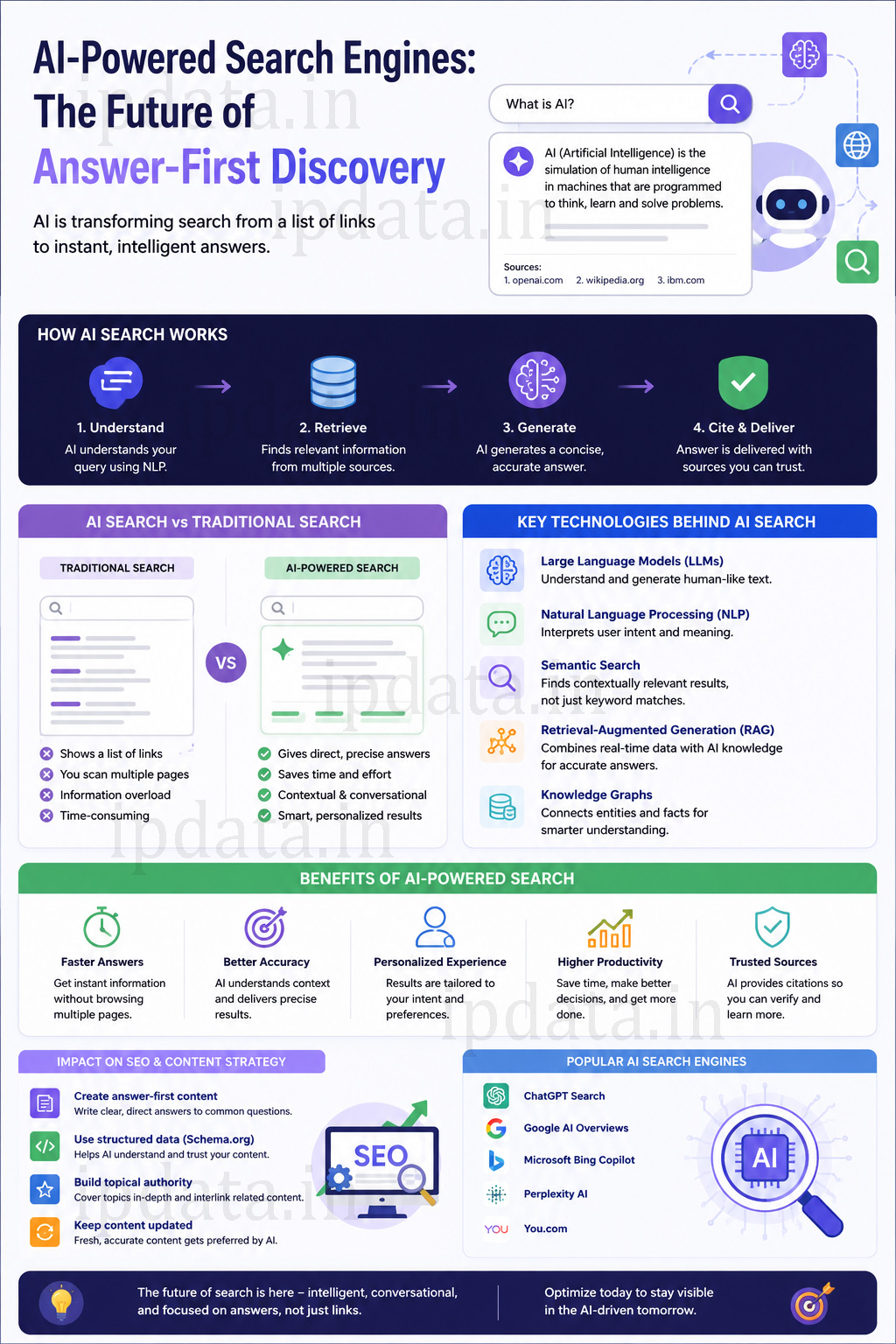
5. How AI-Powered Search Engines Work (Step-by-Step)
- User Query Input Natural language question or prompt
- NLP Analysis Intent, entities, and context extraction
- Data Retrieval Pulls relevant data from indexes, APIs, or documents
- LLM Processing Understands context and reasons over data
- Generative Response Produces a concise, structured answer
- Source Attribution (Optional) Displays references or links
6. Examples of AI-Driven Search Platforms
- Google Search Generative Experience (SGE)
- Bing Copilot
- Perplexity AI
- You.com
- Chat-based search assistants
All of them focus on answers, not just rankings.
7. Benefits of Answer-First Search for Users
Speed
Users get instant answers without browsing multiple pages.
Accuracy
AI filters noise and presents relevant information.
Conversational Experience
Users can ask follow-up questions naturally.
Better UX
Ideal for voice search, mobile, and accessibility.
8. Impact on SEO & Content Creators
AI-powered search is changing SEO forever.
What’s Losing Importance:
- Keyword stuffing
- Thin content
- Click-bait headlines
What Matters More:
- Clear explanations
- Topical authority
- Structured content
- Trust & accuracy
SEO is shifting from ranking pages to training AI systems with quality content.
9. How to Optimize Content for AI Search
Best Practices:
- Use question-based headings
- Write direct answers early in content
- Add FAQ schema
- Use clean formatting
- Cover topics comprehensively
Example:
Instead of writing long introductions, start with:
“Answer-first discovery means…”
10. Developer Perspective: Building AI Search with PHP
Below is a simplified PHP example demonstrating answer-first AI search.
 <?php

$apiKey = 'YOUR_API_KEY';
$query = 'What is answer-first discovery in AI-powered search?';

$request = [
    'model' => 'gpt-4.1-mini',
    'messages' => [
        ['role' => 'system', 'content' => 'You are an AI search engine. Answer clearly and concisely.'],
        ['role' => 'user', 'content' => $query]
    ],
    'max_tokens' => 200
];

$ch = curl_init('https://api.openai.com/v1/chat/completions');
curl_setopt_array($ch, [
    CURLOPT_RETURNTRANSFER => true,
    CURLOPT_POST => true,
    CURLOPT_HTTPHEADER => [
        'Authorization: Bearer ' . $apiKey,
        'Content-Type: application/json'
    ],
    CURLOPT_POSTFIELDS => json_encode($request)
]);

$response = curl_exec($ch);
curl_close($ch);

$result = json_decode($response, true);
echo $result['choices'][0]['message']['content'];
?>
This is the foundation of AI-powered search interfaces in modern applications.
11. Challenges & Ethical Considerations
Accuracy & Hallucinations
AI can generate incorrect answers if not validated.
Data Privacy
User queries may contain sensitive information.
Bias
LLMs may reflect training data biases.
Over-Reliance on AI
Human verification remains essential.
12. The Future of AI-Powered Search
The future includes:
- Fully conversational search engines
- Multimodal search (text, voice, image)
- Personalized knowledge delivery
- Zero-click discovery experiences
Search engines will become AI knowledge companions rather than tools.
AI-powered search engines represent the biggest shift in search since Google’s inception. With Generative AI, NLP, and LLMs, search is evolving into an answer-first, conversational experience.
For businesses, developers, and content creators, adapting to this future is no longer optional—it’s critical.
The Real Market Numbers — Two Very Different Stories
There are two accurate ways to describe the AI search market in mid-2026, and both are true. The confusion comes from treating them as contradictions.
Story 1: AI search is massive and growing fast.
ChatGPT holds approximately 60.7% of the global AI chat assistant share as of January 2026, with Gemini at approximately 15% and Microsoft Copilot at approximately 13.2%, per Similarweb data. ChatGPT Search handles 250 to 500 million weekly queries. Perplexity processes approximately 50 million weekly queries weekly. Perplexity demonstrated the most impressive growth trajectory at 370% year-over-year, positioning itself as an AI-first search engine rather than a general chatbot.
Story 2: Google still dominates referral traffic by an enormous margin.
Google sent 87.63% of all search referral traffic observed by Cloudflare Radar across May 2026. Bing sent 3.45%. TikTok sent 3.26%. Every AI chatbot combined – ChatGPT, Gemini, Claude, and Perplexity – sent 0.29% of search referrals. That’s roughly one-fifth of what DuckDuckGo alone sends.
Both stories are accurate because they measure different things. AI platforms are handling enormous query volume – but AI-generated answers don’t send people to websites the way a list of ten blue links does. ChatGPT processes 2.5 billion prompts daily, 65% of which qualify as search – but the platform has a 96% lower click-through rate than Google. That gap between query volume and referral traffic is the defining tension of AI search in 2026, and any content strategy that ignores it is optimizing for the wrong metric.
Where the Traffic Shift Is Actually Happening
The aggregate numbers hide the most important detail: Google retains dominance on navigational and transactional queries, but ChatGPT Search, Perplexity, and Google AI Mode now capture a meaningful share of research, learning, and commercial investigation queries – the exact segments that historically drove organic traffic to content sites.
Non-branded informational query traffic is down 15–30% across content sites, while eCommerce losses sit at 5–15%. If you run a how-to blog, a technical documentation site, or any content that answers questions rather than sells products, your traffic is in the category experiencing the larger decline – not because your content is worse, but because AI is answering those questions directly.
The counterweight: AI referral traffic converts at 14.2% compared to 2.8% for traditional organic traffic. Fewer visitors, but each visitor sent by an AI platform is dramatically more intentional. The implication for content strategy is a shift from optimizing for volume to optimizing for conversion-weighted visibility.
The Platform Landscape in Mid-2026
Google SGE, Bing Copilot, Perplexity, and You.com as equivalent entries in a bulleted list. That undersells the real differentiation between these platforms in how they operate and who should care about them.
Google AI Mode / AI Overviews
The “Google loses vs. AI” framing misunderstands the market structure. Google is simultaneously the incumbent and a major AI search player. Its AI Mode is available to 2 billion existing search users without requiring download or platform migration – a distribution advantage no other AI platform can match. Google’s AI Overviews reach nearly a billion searchers and pull from top-10 organic results approximately 40% of the time – meaning strong traditional SEO still feeds AI visibility on Google specifically.
ChatGPT Search
ChatGPT Search has grown into one of the top five search properties globally by query volume. Although it’s losing its near-monopoly share to Gemini and Perplexity, projections suggest it will stabilize around 50–55% of the AI chat market as it retains power users while casual users migrate to Gemini. For content strategy, ChatGPT Search rewards topical authority and cites a narrow set of domains – more on that below.
Perplexity AI
Perplexity rewards freshness, authority, and multi-channel presence. It’s the platform most likely to actually send referral traffic because it displays citations prominently and its users are research-oriented rather than task-oriented. If any AI platform behaves most like a traditional search engine for publishers, Perplexity is it.
Microsoft Copilot
Copilot’s share comes primarily through enterprise Microsoft 365 integration. It leans heavily on LinkedIn for B2B queries. For B2B content specifically, this makes LinkedIn presence a factor in AI visibility – a non-obvious channel dependency.
Gemini
Google has responded to AI search by integrating Gemini directly into search results, effectively turning Google into an AI search engine to retain its market share. The business model has shifted toward a mix of premium subscriptions and “Sponsored Citations.” Gemini analyzes multimodal content including video and images – making rich media a differentiator for this platform specifically.
How AI Search Actually Works
AI search as “NLP + LLM + Generative AI” at a high level. More useful is understanding the specific mechanisms these systems use, because each one is something you can influence:
Retrieval-Augmented Generation (RAG)
Most production AI search systems — including Perplexity, ChatGPT Search, and Google AI Mode – don’t answer purely from training data. They retrieve documents first, then generate answers synthesizing those documents. The retrieval step uses embeddings (dense vector representations of text) to find semantically similar content, not keyword matches. This is why a page can rank for a traditional keyword but never appear in AI-generated answers, or vice versa.
Citation Clustering
Roughly 40-55% of ChatGPT Search and Perplexity citations flow to fewer than 1,000 domains. Content without clear topical authority, structured data, and direct answers is systematically excluded from AI-generated responses even when it ranks on traditional Google results.
The domains that capture AI citations aren’t necessarily the ones with the most backlinks or the highest domain authority in the traditional SEO sense. They tend to be the sources with: consistently accurate information on a specific topic, structured formatting that makes facts extractable, and cross-platform presence that reinforces authority signals.
Intent Classification
Where traditional search engines matched keywords, AI search engines classify intent: is this a factual lookup, a comparison request, a recommendation need, a multi-step problem? The answer changes which sources get cited. A page that answers a narrow factual question well will be cited for that question even if it doesn’t rank broadly for related terms.
The Three-Layer Optimization Framework: SEO → AEO → GEO
Treating AI optimization as a single thing. By mid-2026, practitioners have settled on three distinct but complementary disciplines:
SEO makes the page eligible. AEO makes the answer extractable. GEO makes the brand citeable.
SEO (Search Engine Optimization) – Still necessary. Nearly 40% of Google AI Overviews rank in the top-10 organic results, and nearly 70% rank in the top 100. A page that doesn’t rank in traditional search is significantly less likely to appear in AI-generated answers for Google specifically.
AEO (Answer Engine Optimization) – AEO focuses specifically on optimizing content to appear in direct answer formats: featured snippets in Google, voice search answers, and “Position Zero” answer boxes. It’s the established predecessor to GEO, focused on making specific answers extractable. Practically: question-based headings, direct answers in the first paragraph under each heading, FAQ schema markup, and structured data.
GEO (Generative Engine Optimization) – GEO is the practice of structuring digital content and managing online presence to improve visibility in responses generated by AI systems. It influences how large language models retrieve, summarize, and present information. The differentiators for GEO are statistics with attribution, expert quotes, inline citations to reputable sources, and the same facts repeated accurately across platforms.
The most effective strategy in 2026 combines all three disciplines: traditional SEO remains essential for organic search rankings, which still drive the majority of web traffic. GEO adds a new layer focused on earning citations in AI-generated responses.</cite>
Platform-Specific Content Signals
Generic optimization advice treats all AI platforms the same. They’re not. Different platforms reward different signals: Google AI Overviews pull from top-10 results, so traditional SEO remains primary. Perplexity rewards freshness, authority, and multi-channel presence. Microsoft Copilot leans heavily on LinkedIn for B2B queries. Gemini analyzes multimodal content including video and images.
For most content sites, a practical priority order:
- Optimize for traditional Google SEO first — it feeds both Google AI Mode and provides the authority signals other platforms use.
- Add AEO structure (direct answers, FAQ schema) — this improves both Featured Snippet appearance and AI Overviews.
- Build GEO signals (statistics, quotes, cross-platform presence) — this influences citations across Perplexity, ChatGPT Search, and others.
- Consider multimodal content for Gemini-specific visibility if video/image topics are relevant to your niche.
A More Complete PHP Implementation
Minimal OpenAI API call that doesn’t handle errors, doesn’t stream, and uses gpt-4.1-mini — a model name that doesn’t exist (it’s gpt-4o-mini). Here’s a production-shaped AI search interface that includes streaming, proper error handling, and source citation – the features that make an AI search widget actually useful:
<?php
// ai-search.php — a streaming AI search endpoint with source attribution
set_time_limit(0);
header('Content-Type: text/event-stream');
header('Cache-Control: no-cache');
header('X-Accel-Buffering: no'); // Required for Nginx to actually stream

$apiKey = getenv('OPENAI_API_KEY');
if (!$apiKey) {
    echo "data: " . json_encode(['error' => 'API key not configured']) . "\n\n";
    exit;
}

$query = trim($_GET['q'] ?? '');
if (strlen($query) < 3 || strlen($query) > 500) {
    echo "data: " . json_encode(['error' => 'Query must be 3–500 characters']) . "\n\n";
    exit;
}

$payload = [
    'model'    => 'gpt-4o-mini',
    'stream'   => true,
    'messages' => [
        [
            'role'    => 'system',
            'content' => 'You are an AI search assistant. Answer clearly and concisely.
                         Structure your responses with: a direct answer first, then
                         supporting detail, then a brief list of key facts. Always
                         indicate when information may be outdated or requires verification.'
        ],
        [
            'role'    => 'user',
            'content' => $query
        ]
    ],
    'max_tokens' => 500,
];

$buffer = '';

$ch = curl_init('https://api.openai.com/v1/chat/completions');
curl_setopt_array($ch, [
    CURLOPT_POST           => true,
    CURLOPT_POSTFIELDS     => json_encode($payload),
    CURLOPT_HTTPHEADER     => [
        'Content-Type: application/json',
        'Authorization: Bearer ' . $apiKey,
    ],
    CURLOPT_RETURNTRANSFER => false,
    CURLOPT_TIMEOUT        => 0,
    CURLOPT_WRITEFUNCTION  => function ($curl, $chunk) use (&$buffer) {
        $buffer .= $chunk;

        // Process only complete SSE events — never split-JSON
        while (($pos = strpos($buffer, "\n\n")) !== false) {
            $event  = substr($buffer, 0, $pos);
            $buffer = substr($buffer, $pos + 2);
            $line   = trim(str_replace('data:', '', $event));

            if ($line === '' || $line === '[DONE]') {
                if ($line === '[DONE]') {
                    echo "data: [DONE]\n\n";
                    @ob_flush(); @flush();
                }
                continue;
            }

            $decoded = json_decode($line, true);
            if (json_last_error() === JSON_ERROR_NONE) {
                $text = $decoded['choices'][0]['delta']['content'] ?? null;
                if ($text !== null) {
                    echo "data: " . json_encode(['text' => $text]) . "\n\n";
                    @ob_flush(); @flush();
                }
            }
        }
        return strlen($chunk);
    },
]);

curl_exec($ch);

if (curl_errno($ch)) {
    echo "data: " . json_encode(['error' => 'Request failed: ' . curl_error($ch)]) . "\n\n";
}
curl_close($ch);
And the front-end that consumes it cleanly:
<div class="ai-search">
    <input type="text" id="query" placeholder="Ask anything..." maxlength="500">
    <button onclick="search()">Search</button>
    <div id="answer" class="answer-box"></div>
</div>

<script>
let activeSource = null;

function search() {
    const query = document.getElementById('query').value.trim();
    if (!query) return;

    if (activeSource) activeSource.close();

    const answerBox = document.getElementById('answer');
    answerBox.textContent = '';

    activeSource = new EventSource('ai-search.php?q=' + encodeURIComponent(query));

    activeSource.onmessage = (event) => {
        if (event.data === '[DONE]') {
            activeSource.close();
            return;
        }
        const payload = JSON.parse(event.data);
        if (payload.error) {
            answerBox.textContent = 'Error: ' + payload.error;
            activeSource.close();
            return;
        }
        answerBox.textContent += payload.text;
    };

    activeSource.onerror = () => activeSource.close();
}

document.getElementById('query').addEventListener('keydown', (e) => {
    if (e.key === 'Enter') search();
});
</script>
streaming so the answer appears progressively rather than after a multi-second wait, proper SSE buffer handling so partial JSON chunks don’t break the parser, and a system prompt that instructs the model to structure its response in an answer-first pattern rather than preamble-heavy prose.
The Genuine Risks
Hallucinations Are a Structural Problem, Not a Bug to Be Fixed
The more accurate framing: AI search systems generate plausible-sounding answers from probabilistic models, and correctness is a statistical outcome, not a design guarantee. For content that appears in AI-generated answers, this creates a specific risk: your brand or data can be cited in a hallucinated context that misrepresents what you actually said.
The mitigation – structured data, Schema.org markup, clear entity definitions – isn’t just an optimization tactic; it reduces the surface area for misrepresentation by making your facts more extractable in their correct context.
Citation Concentration Is a Market Structure Problem
Citations cluster on a narrow set of authority domains – Reddit, Wikipedia, Stack Overflow, and major news outlets dominate AI answer sourcing. This concentration means most content sites are competing for the remaining 45–60% of citations, and the advantages accrue to whichever sites establish citation foothold first. Late entrants to GEO optimization face a compounding disadvantage as AI models’ citation preferences harden.
The Crawl-to-Refer Ratio
Anthropic’s ClaudeBot crawled 11,122 pages for every 1 human visit Anthropic sent back. OpenAI’s crawl-to-refer ratio is 857:1. Google’s is 5:1. AI companies are consuming content infrastructure at a scale orders of magnitude beyond what they return in traffic. This is an active point of contention between publishers and AI platforms, with several large publishers negotiating licensing deals rather than allowing unrestricted crawling.
What to Actually Do in 2026
Rather than a generic checklist, here are the specific decisions the data above supports:
If you run an informational content site: Expect 15-30% traffic decline on non-branded queries and build measurement around conversion-weighted sessions rather than raw visits. Prioritize GEO signals (statistics with sources, expert quotes, structured FAQ content) for the informational topics most likely to be answered directly by AI.
If you run an eCommerce or transactional site: eCommerce loss sits at 5-15% – significantly less than informational sites.</cite> Transactional and navigational queries remain Google-dominant. Standard SEO plus structured product data remains the primary focus.
If you’re a developer building AI search features: Implement streaming from day one (users tolerate waiting for the first token far better than a 3-second blank page), cache common queries, and build citation display into the UI – users trust sourced answers more than unsourced ones, regardless of accuracy.
The Honest Summary
AI-powered search isn’t replacing Google in 2026. It’s replacing the type of search session that used to generate the most organic traffic – the open-ended informational query where someone wanted to understand something. That’s a meaningful structural shift for content publishers and a relatively minor one for eCommerce. The winners over the next 24 months will be the publishers who understood the distinction early enough to shift their optimization strategy from “rank for terms” to “be cited for topics” – and built their content architecture accordingly.
Frequently Asked Questions
What is an AI-powered search engine?
What is answer-first discovery?
How are AI search engines different from traditional search engines?
Which technologies power AI search engines?
Modern AI search engines rely on:
- Large Language Models (LLMs)
- Natural Language Processing (NLP)
- Machine Learning
- Semantic Search
- Retrieval-Augmented Generation (RAG)
- Knowledge Graphs