

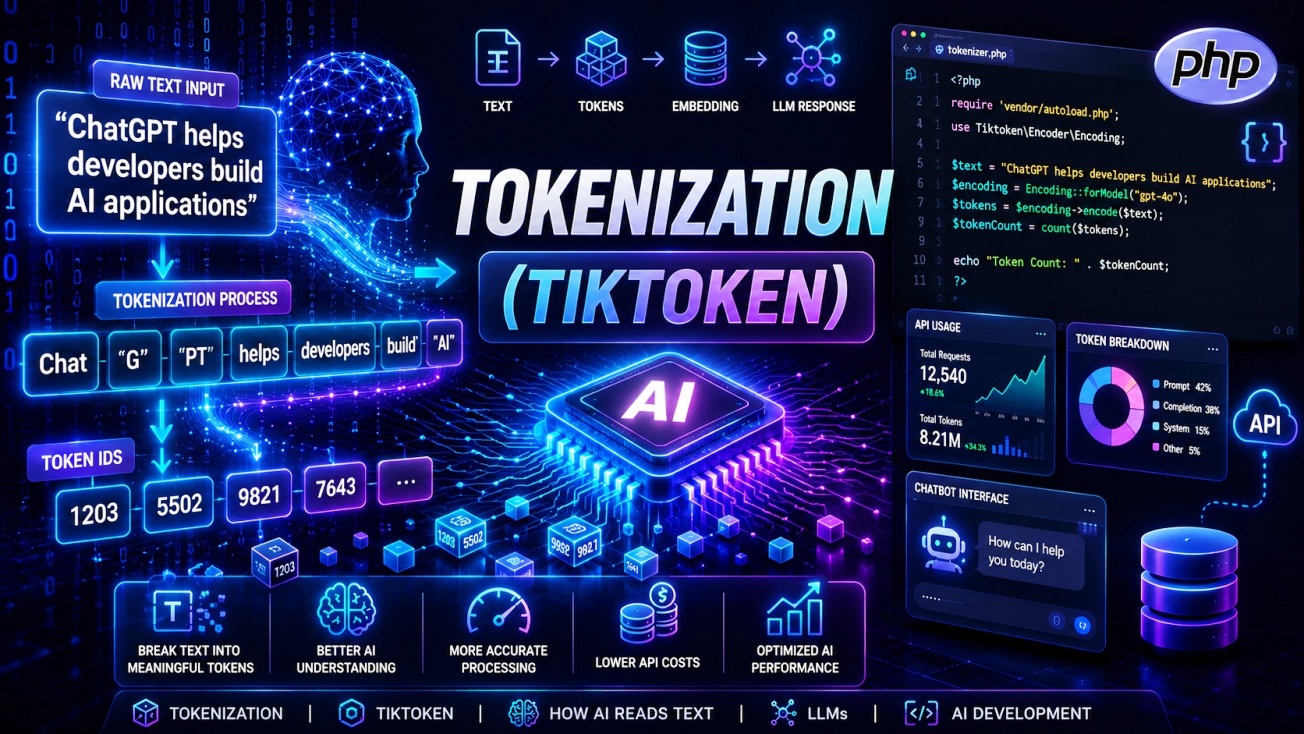
Artificial Intelligence models such as GPT do not understand text exactly like humans do. Before an AI model processes your prompt, the text is converted into smaller pieces called tokens.
These tokens become the actual language units the model reads and processes.
For example:
Input:
ChatGPT is amazing
Possible token breakdown:
["Chat", "G", "PT", " is", " amazing"]
The model works with tokens instead of complete words.
Tokenization directly affects:
- API cost
- performance
- context length
- speed
- prompt optimization
- AI response quality
OpenAI provides Tiktoken, a tokenizer designed specifically for OpenAI models. It converts text into the same token representation used by GPT models.
Why Tokenization Matters
Consider a real production scenario:
You own an AI chatbot website where users upload documents.
Users submit:
5000-word legal document
Your AI model accepts:
128000 tokens
If token limits are exceeded:
- API request fails
- cost increases
- performance drops
- response becomes incomplete
Therefore, token counting before API submission becomes important.
What is Tiktoken?
Tiktoken is an open-source fast tokenizer used by OpenAI.
It performs:
- Text splitting
- Encoding
- Token counting
- Model-specific token calculations
OpenAI supports several encodings:
| Encoding | Models |
|---|---|
| o200k_base | GPT-4o family |
| cl100k_base | GPT-4 / GPT-3.5 / embeddings |
| p50k_base | Codex |
| r50k_base | GPT-3 |
OpenAI recommends selecting encoding based on the model being used.
How Tiktoken Works Internally
Tiktoken primarily uses:
Byte Pair Encoding (BPE)
Process:
Step 1:
Artificial Intelligence
Step 2:
Split into subwords:
Art
ificial
Intelli
gence
Step 3:
Convert into token IDs:
[1203,5511,2881,982]
AI processes these numerical IDs.
Tiktoken vs Alternative Token Counting Methods
| Feature | Tiktoken | Word Count | Character Count | Regex Split | Custom NLP Tokenizer |
|---|---|---|---|---|---|
| GPT accuracy | Very high | Low | Low | Medium | Medium |
| Model specific | Yes | No | No | No | Sometimes |
| Cost prediction | Accurate | Poor | Poor | Poor | Medium |
| Speed | Very fast | Fast | Fast | Medium | Medium |
| Production ready | Yes | No | No | Limited | Depends |
Problems with Simple Word Counting
Many developers do:
str_word_count($text)
Example:
OpenAI's GPT-4o rocks!
Word count:
3
Actual token count:
7–9 tokens (approx)
Because:
- punctuation matters
- spaces matter
- subwords matter
- encoding matters
Word count alone can create inaccurate API billing predictions.
Real Project Scenario
Suppose you are building:
AI Blog Generator SaaS in PHP
Flow:
User writes article
↓
Calculate tokens
↓
Check API limit
↓
Optimize content
↓
Send to OpenAI API
↓
Save token usage
Without token counting:
Problems:
- request failures
- higher cost
- broken responses
PHP Implementation Example
PHP does not have an official native Tiktoken package equivalent to Python, but you can use community libraries or API-based approaches.
Install package:
composer require yethee/tiktoken
PHP code:
<?php

require 'vendor/autoload.php';

use Yethee\Tiktoken\EncoderProvider;

$provider = new EncoderProvider();

$encoder = $provider->getForModel("gpt-4o");

$text="ChatGPT helps developers build AI apps.";

$tokens=$encoder->encode($text);

echo "Token Count: ".count($tokens);

echo "<pre>";
print_r($tokens);

?>
Output:
Token Count: 8

Array
(
[0]=>3574
[1]=>1832
[2]=>920
...
)
Real Production Example: Prevent API Limit Errors
<?php

$maxTokens=100000;

$userContent=$_POST['content'];

$provider = new EncoderProvider();

$encoder=$provider->getForModel("gpt-4o");

$totalTokens=count(
    $encoder->encode($userContent)
);

if($totalTokens>$maxTokens){

die(
"Content too large. Please reduce size."
);

}

echo "Content accepted";

?>
Benefits:
- prevents API failures
- reduces cost
- improves speed
- avoids context overflow
Store Token Usage in Database
SQL table:
CREATE TABLE token_logs(

id INT AUTO_INCREMENT PRIMARY KEY,

user_id INT,

input_tokens INT,

output_tokens INT,

created_at TIMESTAMP DEFAULT CURRENT_TIMESTAMP

);
Insert token data:
mysqli_query(

$conn,

"INSERT INTO token_logs
(user_id,input_tokens)
VALUES
('$userId','$totalTokens')"

);
Useful for:
- user billing
- analytics
- usage reports
- subscription plans
Advanced Optimization Techniques
1. Chunk Long Documents
Instead of:
100000 tokens
Split into:
1000 tokens × 100 chunks
Benefits:
- lower memory usage
- better AI response quality
2. Remove Unnecessary Data
Remove:
- duplicate spaces
- HTML tags
- emojis
- repeated text
Example:
$content=strip_tags($content);

$content=preg_replace(
'/\s+/',
' ',
$content
);
3. Cache Token Counts
Store previous calculations:
Redis
Memcached
Database cache
Benefits:
- faster performance
- reduced processing
Common Mistakes Developers Make
Using word count instead of token count
Wrong:
str_word_count($content)
Correct:
count($encoder->encode($content))
Ignoring system messages
Chat conversations include:
- system messages
- assistant responses
- user prompts
All contribute to total token usage. Community discussions frequently note mismatches when only message text is counted.
Ignoring model encoding
Different models use different token encodings.
Alternative Token Counting Methods – Examples
Developers sometimes avoid model-specific tokenizers and use simpler approaches to estimate token usage. These methods can be useful for rough estimates, but they are usually less accurate than Tiktoken.
1. Word Count Method
This is the simplest approach.
PHP example:
<?php

$text = "ChatGPT helps developers build AI applications.";

$totalWords = str_word_count($text);

echo "Total Words: ".$totalWords;

?>
Output:
Total Words: 6
Problem
GPT models do not process words directly.
For example:
OpenAI's GPT-4o rocks!
Word count:
3
Possible actual tokens:
7–9
Why inaccurate?
- punctuation creates extra tokens
- spaces create tokens
- subwords create tokens
- model encoding differs
2. Character Count Method
Some developers estimate tokens from characters.
Common estimate:
1 token ≈ 4 characters (English approximation)
PHP example:
<?php

$text="ChatGPT helps developers build AI applications.";

$characters=strlen($text);

$estimatedTokens=ceil($characters/4);

echo "Characters: ".$characters."<br>";
echo "Estimated Tokens: ".$estimatedTokens;

?>
Output:
Characters: 48
Estimated Tokens: 12
Problem
This breaks with:
- emojis
- Hindi/Arabic text
- punctuation
- code snippets
Example:
Hello 😊🚀
Character estimates become unreliable.
3. Regex Split Method
Developers sometimes split text manually.
PHP example:
<?php

$text="ChatGPT helps developers build AI applications.";

$tokens=preg_split('/\s+/',$text);

echo "Estimated Tokens: ".count($tokens);

echo "<pre>";
print_r($tokens);

?>
Output:
Estimated Tokens: 6

Array
(
[0]=>ChatGPT
[1]=>helps
[2]=>developers
[3]=>build
[4]=>AI
[5]=>applications
)
Problem
Regex only separates spaces.
GPT tokenizers also consider:
- punctuation
- symbols
- partial words
- encoding rules
4. Custom NLP Tokenizer
Some teams build their own tokenization logic.
Example:
<?php

$text="OpenAI GPT-4o rocks!";

$text=strtolower($text);

$text=preg_replace(
'/[^a-z0-9 ]/',
'',
$text
);

$tokens=explode(' ',$text);

print_r($tokens);

?>
Output:
Array
(
[0]=>openai
[1]=>gpt4o
[2]=>rocks
)
Problem
Custom implementations often:
- miss special characters
- break multilingual content
- fail for code blocks
- differ from actual model tokens
Real Comparison Example
Input:
ChatGPT helps developers build AI applications.
| Method | Result |
|---|---|
| Word Count | 6 |
| Character Estimate | 12 |
| Regex Split | 6 |
| Custom NLP | 6 |
| Tiktoken | 8–10 (model dependent) |
Tiktoken varies by model encoding and is generally the closest representation of what the API actually processes.
Production Recommendation
Use cases:
Small blog estimate
str_word_count()
Basic approximation
strlen()/4
Production AI systems
$tokens=count(
$encoder->encode($content)
);
Examples:
- AI chatbots
- RAG applications
- AI article generators
- document summarizers
- billing systems
- OpenAI API integrations
For production systems where API cost and context windows matter, model-specific tokenization is usually the preferred approach.
Tiktoken is not simply a token counter.
It is a production-grade tokenizer that helps developers:
- estimate AI cost
- stay within token limits
- optimize prompts
- improve application performance
- build scalable AI products
If you are building:
- AI chatbots
- AI SaaS platforms
- document summarizers
- AI content generators
- RAG systems
- OpenAI integrations in PHP
then Tiktoken should be part of your architecture.
Frequently Asked Questions
1. What is Tokenization in AI?
Tokenization is the process of breaking text into smaller units called tokens before an AI model processes it. A token can be a word, part of a word, punctuation mark, or special character.
Example:
Input:
ChatGPT helps developersTokens:
["Chat", "G", "PT", "helps", "developers"]AI models understand tokens rather than complete sentences.
+2. What is Tiktoken?
Tiktoken is a fast tokenizer library developed for OpenAI models. It converts text into tokens using model-specific encoding and helps developers calculate token usage accurately.
Tiktoken helps with:
- token counting
- cost estimation
- context window management
- prompt optimization
+3. Why is token counting important?
Token counting is important because OpenAI APIs use tokens for:
- pricing calculations
- context limits
- request processing
- performance optimization
Incorrect estimates can cause:
- API failures
- higher costs
- incomplete responses
+4. Is word count the same as token count?
No.
Word count and token count are different.
Example:
Text:
OpenAI's GPT-4o rocks!Word count:
3 wordsToken count may be:
7–9 tokensTokens include spaces, punctuation, and subword fragments.
+5. Which is better: Tiktoken or word count?
Tiktoken is much more accurate than word count.
Method Accuracy Word Count Low Character Count Medium Regex Split Medium Tiktoken High For production AI applications, Tiktoken is generally preferred.
+6. Can I use Tiktoken with PHP?
Yes.
PHP does not include native Tiktoken support, but community packages can be used.
Example:
<composer require yethee/tiktokenBasic usage:
$provider = new EncoderProvider();
$encoder = $provider->getForModel("gpt-4o");
$count = count(
$encoder->encode($text)
);+7. What are alternative token counting methods?
Common alternatives include:
- Word Count
- Character Count
- Regex Split
- Custom NLP Tokenizers
These methods provide estimates but may not match actual AI token usage.
+8. Does Tiktoken work for all OpenAI models?
Tiktoken supports different encodings for different model families.
Examples:
- o200k_base
- cl100k_base
- p50k_base
- r50k_base
The encoding should match the model being used.
+9. How can token counting reduce API cost?
By calculating tokens before sending requests, developers can:
- remove unnecessary content
- split large documents
- reduce prompt size
- avoid context overflow
This improves efficiency and can lower usage costs.
+10. Which projects should use Tiktoken?
Tiktoken is useful for:
- AI chatbots
- document summarizers
- RAG applications
- AI SaaS platforms
- content generators
- OpenAI API integrations
- billing and analytics systems
These FAQs are optimized for FAQ schema and long-tail search queries.
Write a CommentRead Next
Hidden WordPress Admin Backdoor: How Hackers Hide Administrator Accounts in WordPress | How to Identify, Investigate, and Remove Malicious User-Hiding Code
WordPress powers over 40% of websites on the internet, making it one of the most attractive targets for cybercriminals. While many website…Prompt Injection Attacks: The SQL Injection of the AI Era
Large Language Models (LLMs) such as ChatGPT, Claude, Gemini, Copilot, and AI-powered enterprise assistants are transforming software…How I Investigated a Hacked WordPress Website: Finding the Entry Point on an AWS Apache Server
A hacked WordPress site presents two simultaneous pressures: get the site back up (business pressure) and understand what happened (security…Subscribe to our Newsletter
Subscribe to our email newsletter to get the latest posts delivered right to your email.Pure inspiration, zero spam ✨