
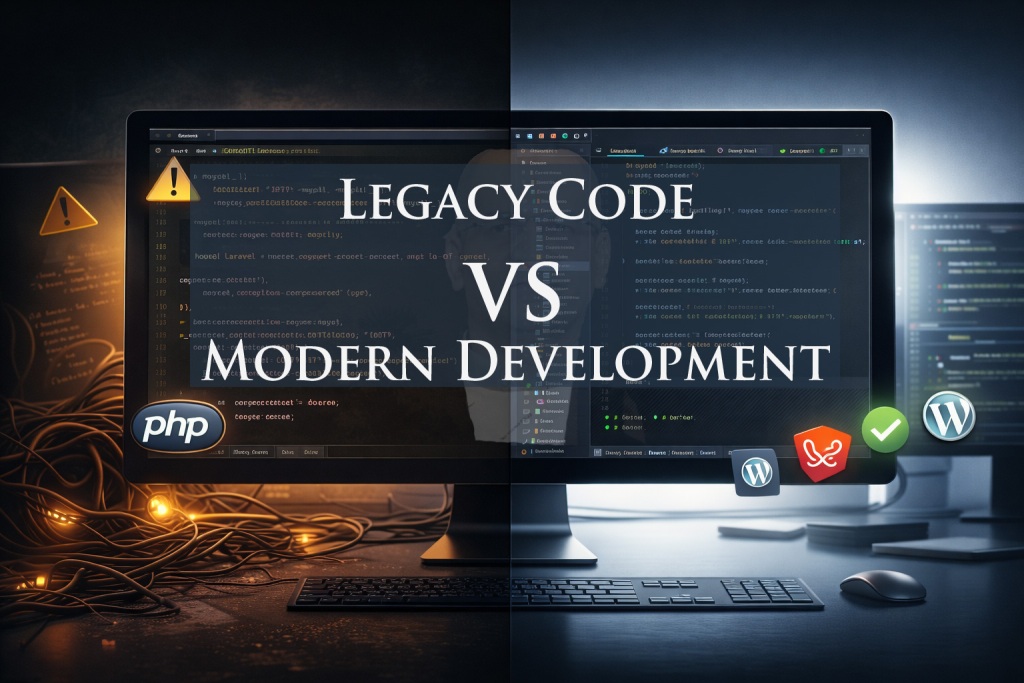
In the world of software development, legacy code is a term that almost every developer encounters at some point—whether maintaining an old client project or upgrading an in-house application. But what exactly makes code “legacy,” and why is working with it often more difficult than writing new code? Understanding these challenges and having a strategy to address them is essential for PHP, Laravel, and WordPress developers alike.
What Is Legacy Code?
In simple terms, legacy code refers to any existing codebase that is in use but difficult to understand, modify, or extend. It often lacks proper tests, documentation, or modern practices—and that’s precisely what makes it risky to work with. Some definitions even say legacy code is simply code without tests, underscoring the fear developers feel when altering it without safety nets.
In PHP ecosystems—whether plain PHP apps, Laravel frameworks, or WordPress plugins/themes—legacy code can come from old PHP versions, outdated dependencies, or years of accumulated technical debt.
Why Legacy Code Survives
Despite its drawbacks, legacy code continues to stay in production for several reasons:
1. Critical Business Dependencies
Many legacy applications support essential workflows that businesses rely on daily. Rewriting them poses a risk to uptime and continuity.
2. Migration Costs
Rebuilding or migrating a large codebase—especially in PHP where dependencies and integrations are deep—can be expensive and resource-intensive.
3. Data and Integration Concerns
Legacy systems often contain large amounts of historical data and bespoke integrations. Shifting or mapping this to a new stack may introduce compatibility issues or data loss.
4. Human Resistance
Developers and stakeholders may prefer the “devil they know” over the uncertainty of big rewrites. This cultural resistance slows modernization efforts.
Key Challenges of Legacy Code
1. Maintenance & Modification Difficulties
Old logic, tangled dependencies, and lack of clear structure make finding and fixing bugs difficult.
2. Integration With Modern Tools
Legacy systems weren’t designed for APIs, cloud services, microservices, or modern deployment pipelines, making extension or scaling harder.
3. Performance & Scalability
Older PHP systems may not take advantage of modern optimizations and can struggle under high traffic or data volume.
4. Security Vulnerabilities
Without modern practices like sanitization, up-to-date libraries, or automated security checks, legacy code can expose apps to attack.
5. Lack of Documentation and Expertise
Developers often inherit code they didn’t write. Without documentation, understanding it becomes a guessing game—making safe changes harder.
Tools to Tackle Legacy Code
Successful legacy code work requires the right toolkit. Here are some essential ones:
🔹 Static Analysis Tools
Automated tools scan code for issues, security flaws, and code smells. Tools like PHPStan, Psalm, and SonarQube help you detect hidden problems and enforce standards.
🔹 Automated Testing Frameworks
Testing provides confidence. In PHP you can use:
- PHPUnit for unit tests
- Laravel Dusk for browser tests
- Behat for behavior-driven tests
These frameworks help catch regressions as you refactor.
🔹 Documentation Generators
Legacy code often lacks documentation. Tools like Doxygen, phpDocumentor, or AI-powered systems (like Swimm) can generate and maintain docs directly from the codebase.
🔹 Migration and Modernization Tools
For PHP upgrades (e.g., from PHP 5.x to PHP 8+), tools like Rector and adapters like Laravel Shift can automate many refactorings. Community discussions show these tools can significantly ease upgrades by handling dependencies and compatibility issues.
🔹 Continuous Integration (CI/CD)
Using CI tools (GitHub Actions, Jenkins, GitLab CI) ensures tests and checks run automatically on each commit—preventing regression and ensuring quality.
Best Practices: Tips to Overcome Legacy Code Challenges
1. Start With Testing
Build a characterization test suite before making changes. Tests act as a safety net and clarify currently supported behavior.
2. Read and Document Existing Code
Review whatever documentation exists, and generate new docs for unclear areas. Over time, this investment pays huge dividends.
3. Refactor Incrementally
Rather than rewriting everything, improve small parts of the codebase at a time. This maintains stability while reducing technical debt.
4. Use Version Control
Git and branching strategies allow you to track changes, revert mistakes, and isolate feature work from refactors.
5. Apply Modern PHP Standards
Adopt PSR standards (PSR-1, PSR-4, PSR-12) for consistency. Add strict typing and modern syntax when possible.
6. Limit Scope of Changes
Large, sweeping changes increase risk. Break work into reviewable pieces to simplify code intervention and reduce error likelihood.
7. Stay Security-Focused
Regularly scan for vulnerabilities, especially in WordPress plugins or Laravel dependencies, and update them regularly.
Special Considerations: WordPress & Laravel
WordPress
Legacy WordPress often uses procedural PHP, outdated plugins, and themes without separation of concerns. Improve maintainability by:
- Replacing deprecated functions
- Using modern build tools and templating
- Introducing object-oriented patterns in plugins
Security audits and dependency updates are critical here.
Laravel
Legacy Laravel apps might mix old patterns with new ones (e.g., mixing logic in controllers rather than Jobs/Services). Refactoring towards SOLID principles and service layers enhances clarity and testability.
Legacy Code Examples (Before & After)
1. Plain PHP Legacy Code Example
Legacy PHP Code (Hard to Maintain)
<!--?php <br ?--> mysql_connect("localhost", "root", "");
mysql_select_db("test");
$result = mysql_query("SELECT * FROM users WHERE status = 1");
while ($row = mysql_fetch_array($result)) {
echo $row['name'] . "
";
}
?>
Problems
- Deprecated mysql_* functions
- No error handling
- No separation of concerns
- No security (SQL injection risk)
Modern PHP Refactored Code
<!--?php $pdo = new PDO( "mysql:host=localhost;dbname=test;charset=utf8", "root", "", [PDO::ATTR_ERRMODE => PDO::ERRMODE_EXCEPTION]<br ?--> );
$stmt = $pdo->prepare("SELECT name FROM users WHERE status = :status");
$stmt->execute(['status' => 1]);
foreach ($stmt as $row) {
echo htmlspecialchars($row['name']) . "
";
}
Improvements
- Secure prepared statements
- PDO with exceptions
- Better readability & maintainability
2. Laravel Legacy Code Example
Legacy Laravel Controller (Fat Controller)
public function store(Request $request)
{
$user = new User();
$user->name = $request->name;
$user->email = $request->email;
$user->save();

Mail::send('emails.user', ['user' => $user], function ($m) use ($user) {
$m->to($user->email)->subject('Welcome');
});

return redirect()->back();
}
Problems
- Business logic inside controller
- Hard to test
- Poor separation of concerns
Refactored Laravel Code (Service + Job)
UserService.php
class UserService
{
public function create(array $data): User
{
return User::create($data);
}
}
SendWelcomeEmail.php
class SendWelcomeEmail implements ShouldQueue
{
public function __construct(private User $user) {}

public function handle()
{
Mail::to($this->user->email)
->send(new WelcomeMail($this->user));
}
}
Controller
public function store(Request $request, UserService $service)
{
$user = $service->create($request->validated());

dispatch(new SendWelcomeEmail($user));

return back();
}
Improvements
- SOLID principles
- Testable architecture
- Scalable & maintainable
3. WordPress Legacy Code Example
Legacy WordPress Code
add_action('init', function () {
if ($_POST['email']) {
global $wpdb;
$wpdb->query(
"INSERT INTO wp_subscribers (email) VALUES ('{$_POST['email']}')"
);
}
});
Problems
- SQL injection risk
- No nonce verification
- No sanitization
- Executes on every page load
Secure & Modern WordPress Code
add_action('admin_post_save_subscriber', 'save_subscriber');

function save_subscriber()
{
if (!isset($_POST['_wpnonce']) ||
!wp_verify_nonce($_POST['_wpnonce'], 'save_subscriber')) {
wp_die('Security check failed');
}

global $wpdb;

$email = sanitize_email($_POST['email']);

$wpdb->insert(
$wpdb->prefix . 'subscribers',
['email' => $email],
['%s']
);

wp_redirect(home_url('/thank-you'));
exit;
}
Improvements
- Nonce verification
- Data sanitization
- Secure database insert
- Performance-friendly hooks
Legacy code doesn’t have to be a burden—with the right strategy, tooling, and mindset, you can transform it into a maintainable and robust foundation for future development. Whether you’re dealing with old PHP systems, outdated WordPress plugins, or complex Laravel apps, the combination of tests, automation, documentation, and incremental improvements is your strongest approach.
Remember: legacy code is not dead code—it’s code that still matters. The key to success is evolving it safely, sustainably, and confidently.