

Introduction
Every dynamic web application relies heavily on databases for storing, retrieving, and managing data. As a developer, understanding database interaction is essential — it’s how your application communicates with data stored in systems like MySQL, PostgreSQL, or SQLite.
In this guide, we’ll dive into the CRUD model (Create, Read, Update, Delete) and explore Object-Relational Mapping (ORM) — a modern way to simplify database operations.
1. What Is Database Interaction?
Database interaction refers to the communication between your application’s code and its database. Through queries, data can be created, read, updated, or deleted.
Developers use either:
- Raw SQL queries (traditional method), or
- ORM (Object-Relational Mapping) (modern, object-oriented approach).
2. Understanding CRUD Operations
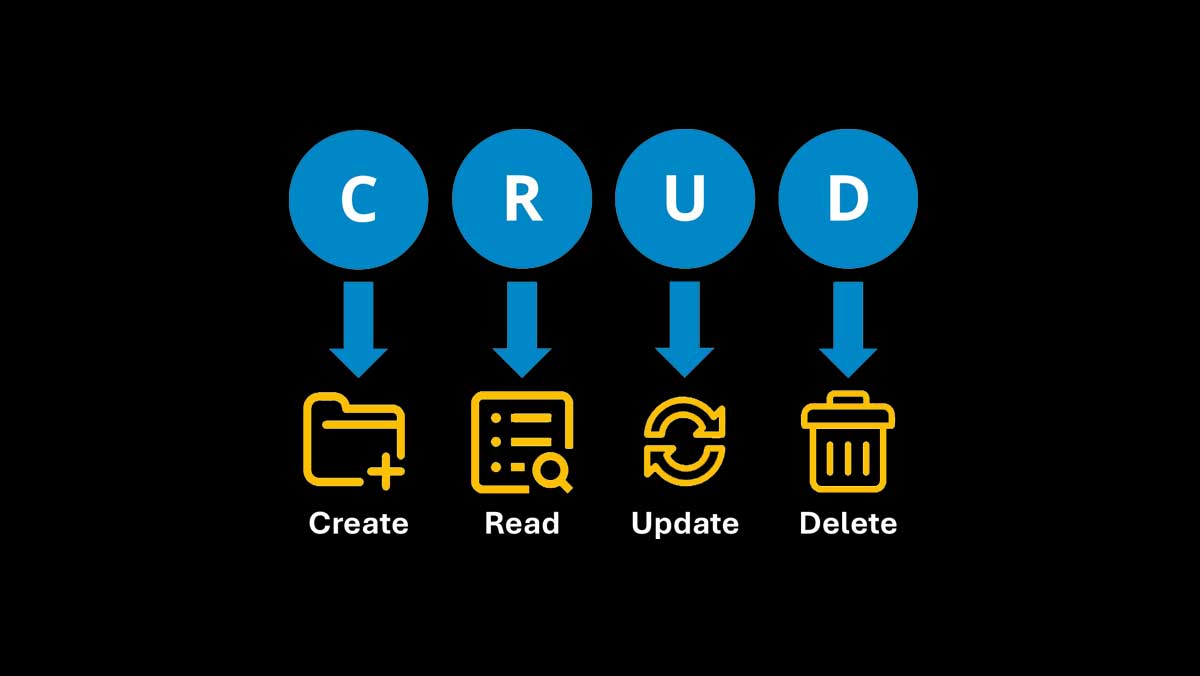
CRUD stands for Create, Read, Update, and Delete — the four basic operations for managing data in a database table.
Let’s break it down with MySQL + PHP examples.
2.1 Create (Insert Data)
The Create operation adds a new record to your database.
$sql = "INSERT INTO users (name, email) VALUES ('John Doe', 'john@example.com')";
mysqli_query($conn, $sql);
Best Practice: Always use prepared statements to prevent SQL injection:
$stmt = $conn->prepare("INSERT INTO users (name, email) VALUES (?, ?)");
$stmt->bind_param("ss", $name, $email);
$stmt->execute();
2.2 Read (Fetch Data)
The Read operation retrieves stored records.
$result = $conn->query("SELECT * FROM users");
while($row = $result->fetch_assoc()) {
    echo $row['name'] . " - " . $row['email'] . "<br>";
}
Tip: Use LIMIT and WHERE clauses for performance optimization.
2.3 Update (Modify Data)
To modify existing records:
$sql = "UPDATE users SET email='newemail@example.com' WHERE id=1";
mysqli_query($conn, $sql);
Pro Tip: Always verify which record you are updating — accidental updates can overwrite data globally.
2.4 Delete (Remove Data)
To delete a record:
$sql = "DELETE FROM users WHERE id=1";
mysqli_query($conn, $sql);
Caution: Always add a WHERE condition to avoid deleting all rows!
3. What Is ORM (Object-Relational Mapping)?
While raw SQL gives full control, it can become repetitive and error-prone. ORM is a technique that lets developers interact with the database using objects instead of SQL queries.
ORM translates your object-oriented code into SQL commands behind the scenes.
Advantages of Using ORM
- ✅ Reduces boilerplate SQL code
- ✅ Prevents SQL injection automatically
- ✅ Easier maintenance and scalability
- ✅ Compatible with multiple databases (MySQL, PostgreSQL, SQLite)
4. Popular PHP ORMs
If you’re a PHP developer, you can use several ORM libraries:
| ORM Library | Framework | Key Feature |
|---|---|---|
| Eloquent ORM | Laravel | Intuitive Active Record pattern |
| Doctrine ORM | Symfony | Flexible, powerful query builder |
| Propel ORM | Independent | Lightweight and easy integration |
Example: CRUD in Laravel Eloquent ORM
// Create
User::create(['name' => 'John', 'email' => 'john@example.com']);

// Read
$users = User::all();

// Update
$user = User::find(1);
$user->email = 'new@example.com';
$user->save();

// Delete
User::destroy(1);
Why Developers Prefer ORM:
This single syntax replaces multiple lines of SQL, improving both readability and maintainability.
5. When to Use ORM vs Raw SQL
| Use Case | Recommended Approach |
|---|---|
| Simple applications | ORM for simplicity |
| Complex joins or high-performance queries | Raw SQL or Query Builder |
| Multi-database systems | ORM for portability |
| Real-time analytics | Raw SQL for speed |
6. Best Practices for Database Interaction
- Always sanitize inputs (even with ORM).
- Use transactions for critical operations (insert/update/delete).
- Index your tables for faster queries.
- Backup regularly and monitor query performance.
- Use connection pooling in high-traffic systems.
Conclusion
Database interaction is the foundation of every dynamic application. Mastering CRUD operations builds your core understanding, while adopting ORM makes your development cleaner and faster.
Whether you’re managing a small user database or architecting enterprise-scale systems, the combination of CRUD principles and ORM techniques ensures your application remains secure, maintainable, and scalable.